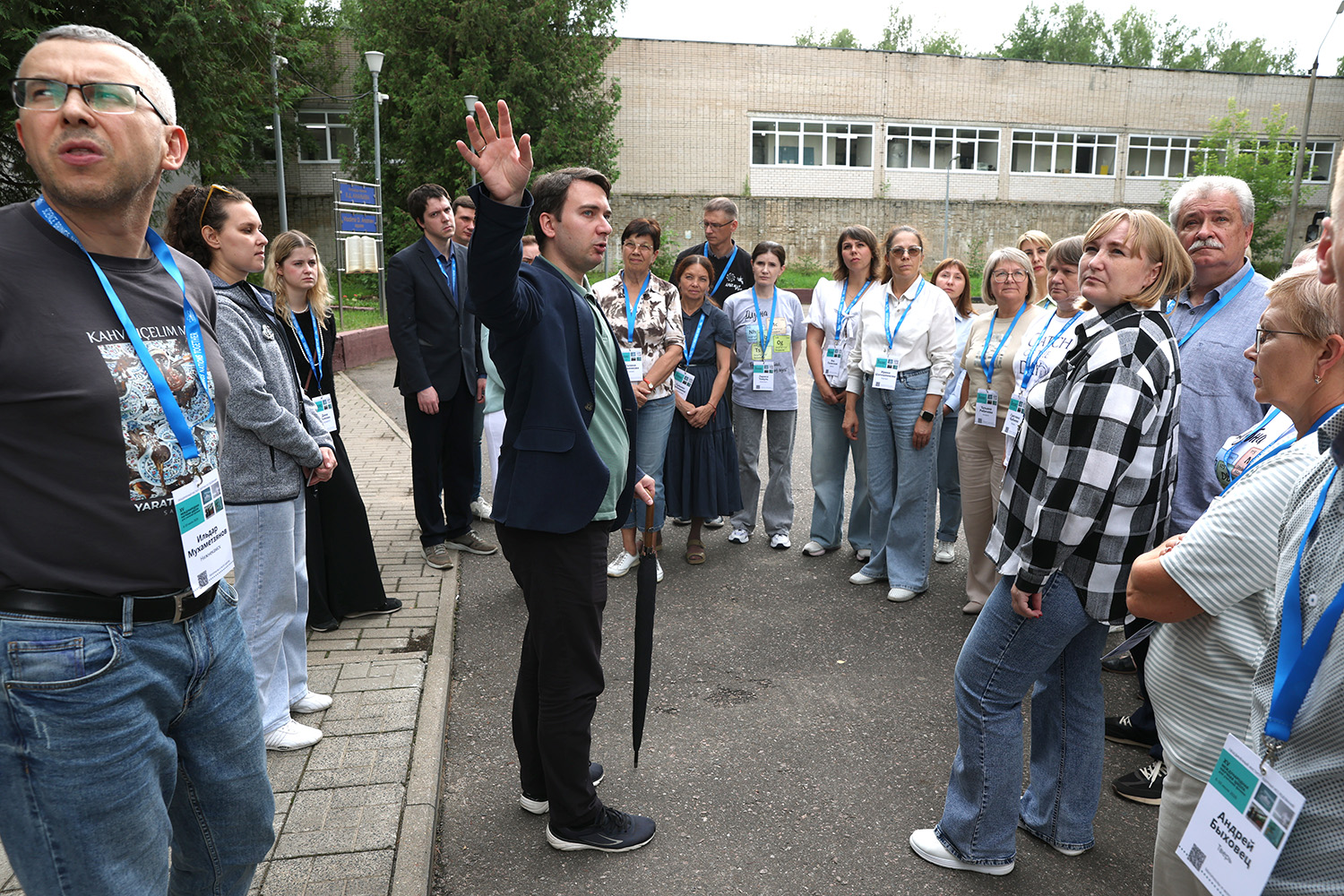

From 6 to 10 July 2026, JINR hosted the XV International Scientific School for Physics Teachers. The event brought together 23 educators from different regions of Russia – from the Far East to the North Caucasus.
The traditional goal of the School is to bridge the gap between school education and fundamental science, to promote natural science knowledge, and to familiarise participants with the research areas of JINR. Recently, a special feature of these Schools has been the introduction to the "Engineers of the Future" teaching and learning package, along with the opportunity to discuss its use with the author team from JINR led by Professor Yuri Panebrattsev.
The week-long programme included lectures on the main research topics of the Institute, excursions to operating facilities, masterclasses in the laboratory workshop and the Virtual Laboratory for nuclear physics studies, as well as a sightseeing tour of Dubna.
On the final day of the School, a round‑table discussion was held with the participation of UC Director Dmitry Kamanin. Andrey Denikin, Rector of Dubna State University, also gave a short presentation during the meeting. He spoke about how students can start building their scientific careers at JINR from their early university years, and how the Institute's basic departments can help them find their own path into research. He encouraged the teachers to share this information with their students.
During the round‑table discussion, the teachers shared not only their impressions of the School, but also the professional challenges they face in their daily work: a shortage of modern equipment, a lack of methodological support for certain topics, difficulties in preparing students for the physics state exams (especially in regions where access to laboratory and advisory resources is limited), general problems of engaging schoolchildren in the subject, as well as the motivating role of large research organisations and JINR's educational projects.
Participants shared their impressions of the week spent in Dubna.
Larisa Tomul, Ulyanovsk Aviation College, Ulyanovsk
The programme is very intensive, covering different aspects of activity. Lectures and practical sessions alternate, which allowed us to get tired and also have some rest in between (tired in a good sense of the word).
Irina Shaposhnikova, Barnaul Classical School, Barnaul
The organisers managed to combine the methodological, scientific and practical parts very well. Everything flowed logically from one part to the next. Each day was different.
Lyudmila Rodionova, Gymnasium No. 33, Ulyanovsk
These five days in Dubna have been a real game‑changer for me professionally. I arrived with the usual set of school programmes and teaching materials, but I am leaving with a completely different understanding of what it means to be a physics teacher today. Physics here ceases to be abstract – it becomes something you can touch, see, and make sense of. Seeing how colleagues are already using the "Engineers of the Future" teaching package, hearing real‑life cases and recommendations – this is invaluable. I am leaving not just with a folder of materials, but with a renewed outlook on my profession, new contacts, and a firm conviction that these Schools should become a tradition.
Inga Kochetkova, Sovkhoznaya Secondary School, Sovkhozny village, Udmurt Republic
Special thanks go to the lecturers for the sessions and excursions – they were knowledgeable and presented everything so clearly. I have only warm memories of the School.
Svetlana Babaeva, Multidisciplinary Lyceum No. 187, Kazan
The programme left a strong impression on me. I saw scientists, passionate about their work. The NICA collider is impressive in its scale. Now I know that scientists from different parts of the world work together on global issues.
Natalia Protsenko, Michurinsk Secondary School No. 123, Elitny, Novosibirsk Region
For me, this was a unique experience of immersion into science. I will certainly share my impressions of the School with my colleagues. And I will tell my students about the opportunities in modern nuclear physics and how they can apply their skills in this field.